Price$1.65 – $8.50
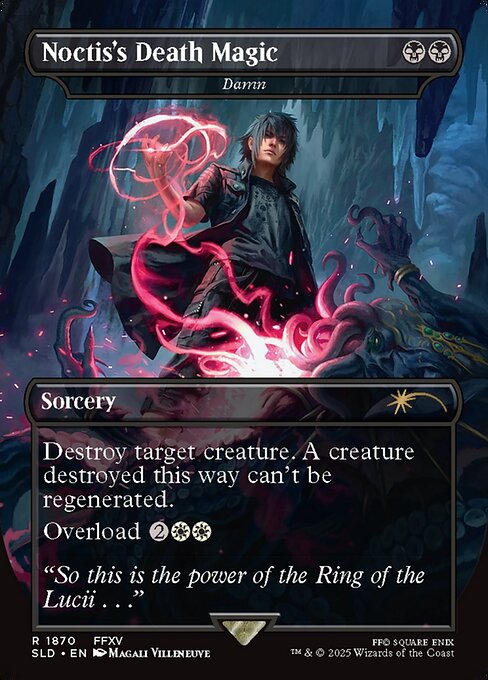
Buy on TCGplayerDamn

Sorcery
LegalRemovalRank #334
Destroy target creature. A creature destroyed this way can't be regenerated.
Overload 
 (You may cast this spell for its overload cost. If you do, change "target" in its text to "each.")
KeywordsOverload
Why is this card good?
Damn is one of the most efficient and flexible removal spells in Orzhov/Mardu/Esper colors, and the reason is its modality: it's a two-mana spot removal and a four-mana board wipe stapled together.
Early game, you cast it for to kill an opposing commander or threat. Later, when the board spirals out of control, you overload it for to Wrath the table. You almost never want this dead in hand — a rare quality for a removal card. Compare it to Damnation: same cost to wipe, but Damn does double duty.
Who wants it: basically every deck with white and black. Control, midrange, stax, and Voltron decks all appreciate cheap interaction that scales. It's especially good in lower-power pods where board states stick.
When to skip it: dedicated go-wide tokens or aristocrats decks where you're the one flooding the board — you'd rarely overload it, and a pure spot-removal slot might serve you better.
to kill an opposing commander or threat. Later, when the board spirals out of control, you overload it for to Wrath the table. You almost never want this dead in hand — a rare quality for a removal card. Compare it to Damnation: same cost to wipe, but Damn does double duty.
Who wants it: basically every deck with white and black. Control, midrange, stax, and Voltron decks all appreciate cheap interaction that scales. It's especially good in lower-power pods where board states stick.
When to skip it: dedicated go-wide tokens or aristocrats decks where you're the one flooding the board — you'd rarely overload it, and a pure spot-removal slot might serve you better.Related cards
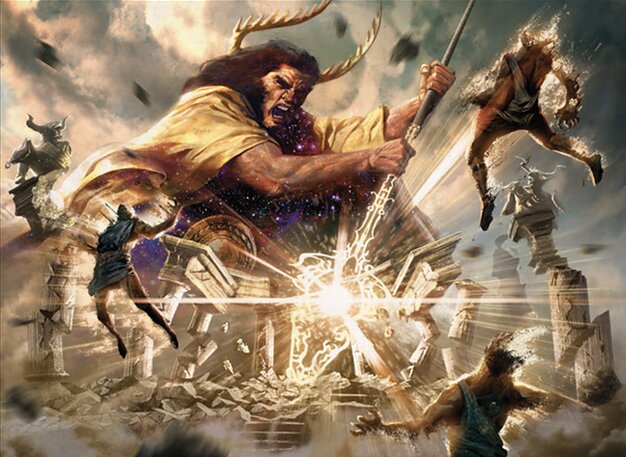
Wrath of God
Classic 4-mana board wipe destroying all creatures, Damn's overload mirror.

Damnation
Black version of Wrath, mono-color mass creature destruction at four mana.
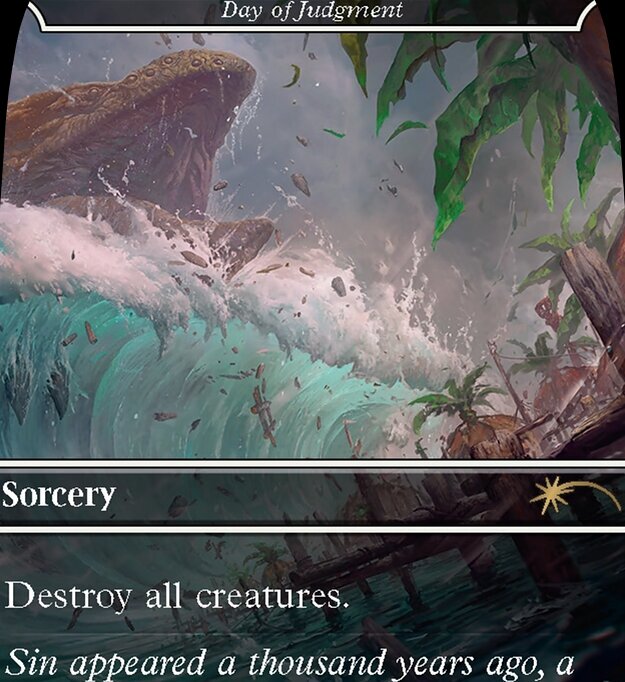
Day of Judgment
Straightforward white four-mana destroy-all-creatures sweeper.

Toxic Deluge
Flexible black wrath that gets around indestructible via -X/-X.

Supreme Verdict
Uncounterable Azorius wrath in same WB-adjacent control role.

Doom Blade
Cheap targeted single-creature removal like Damn's base mode.

Go for the Throat
Two-mana efficient single-target creature kill spell.

Vanquish the Horde
Scaling white mass removal that punishes go-wide boards.
Printings (9)
Show all 9 printingsShow fewer
Played by these commanders
Temmet, Naktamun's Will100% of 1
Clavileño, First of the Blessed100% of 1
Combos (8)
- Overseer of the Damned + Dictate of Erebos + Ashnod's Altar
→ Each opponent sacrifices any creature that enters under their control, Each opponent sacrifices all creatures they control, Lock
- Overseer of the Damned + Dictate of Erebos + Phyrexian Altar
→ Each opponent sacrifices any creature that enters under their control, Each opponent sacrifices all creatures they control, Lock
- Songs of the Damned + Chthonian Nightmare + Pinnacle Monk // Mystic Peak
→ Infinite LTB, Infinite ETB, Infinite sacrifice triggers
- Overseer of the Damned + Dictate of Erebos + Viscera Seer
→ Each opponent sacrifices any creature that enters under their control, Each opponent sacrifices all creatures they control, Lock
- Overseer of the Damned + Dictate of Erebos + Altar of Dementia
→ Each opponent sacrifices any creature that enters under their control, Each opponent sacrifices all creatures they control, Lock
- Songs of the Damned + Chthonian Nightmare + Eternal Witness
→ Infinite LTB, Infinite ETB, Infinite sacrifice triggers
Rulings (4)
- 2024-01-12
If you don't pay the overload cost of a spell with overload, that spell will have a single target. If you pay the overload cost, the spell won't have any targets.
- 2024-01-12
Because a spell with overload doesn't target when its overload cost is paid, it may affect permanents with hexproof or with protection from the appropriate color.
- 2024-01-12
To determine the total cost of a spell, start with the mana cost or alternative cost you're paying (such as an overload cost), add any cost increases, then apply any cost reductions. The mana value of the spell remains unchanged, no matter what the total cost to cast it was.
- 2024-01-12
If you are instructed to cast a spell with overload "without paying its mana cost," you can't choose to pay its overload cost instead.